PL
 EN
 DE

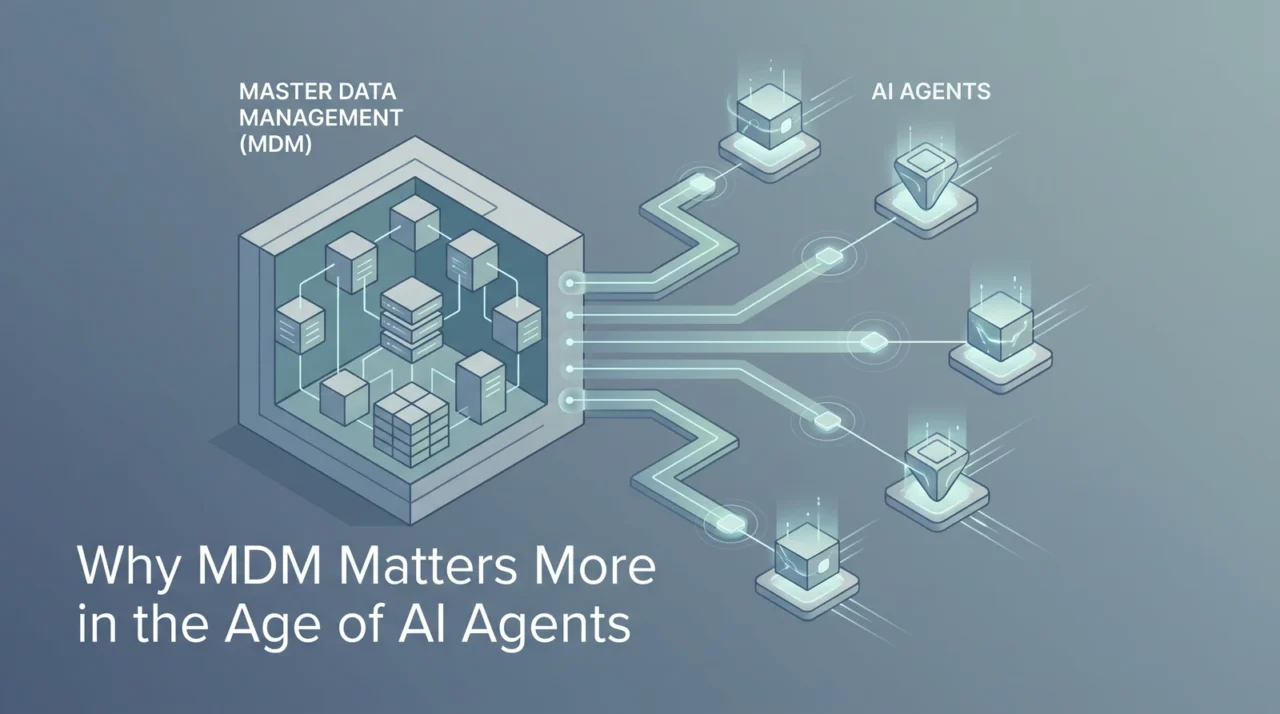
MDM delivers business value long before AI enters the picture
Master Data Management (MDM) solves business problems independently of artificial intelligence. Enterprises rely on trusted master data to support product consistency, streamline operations, and build a 360-degree customer view. At Holiday Inn Club Vacations, MDM consolidated seven different data systems into one to manage more than 350,000 member profiles, reducing data-entry errors while supporting more customer-specific personal touches. At Discount Tire, MDM managed 70 million customer records and cut duplication by 50%.
These examples illustrate why MDM investments can be justified through operational improvements alone, including fewer duplicate records, more consistent customer information, and more reliable processes across business systems. AI introduces further opportunities to use that trusted foundation, but it is not a prerequisite for realizing its value.
AI agents make trusted master data more important, not less
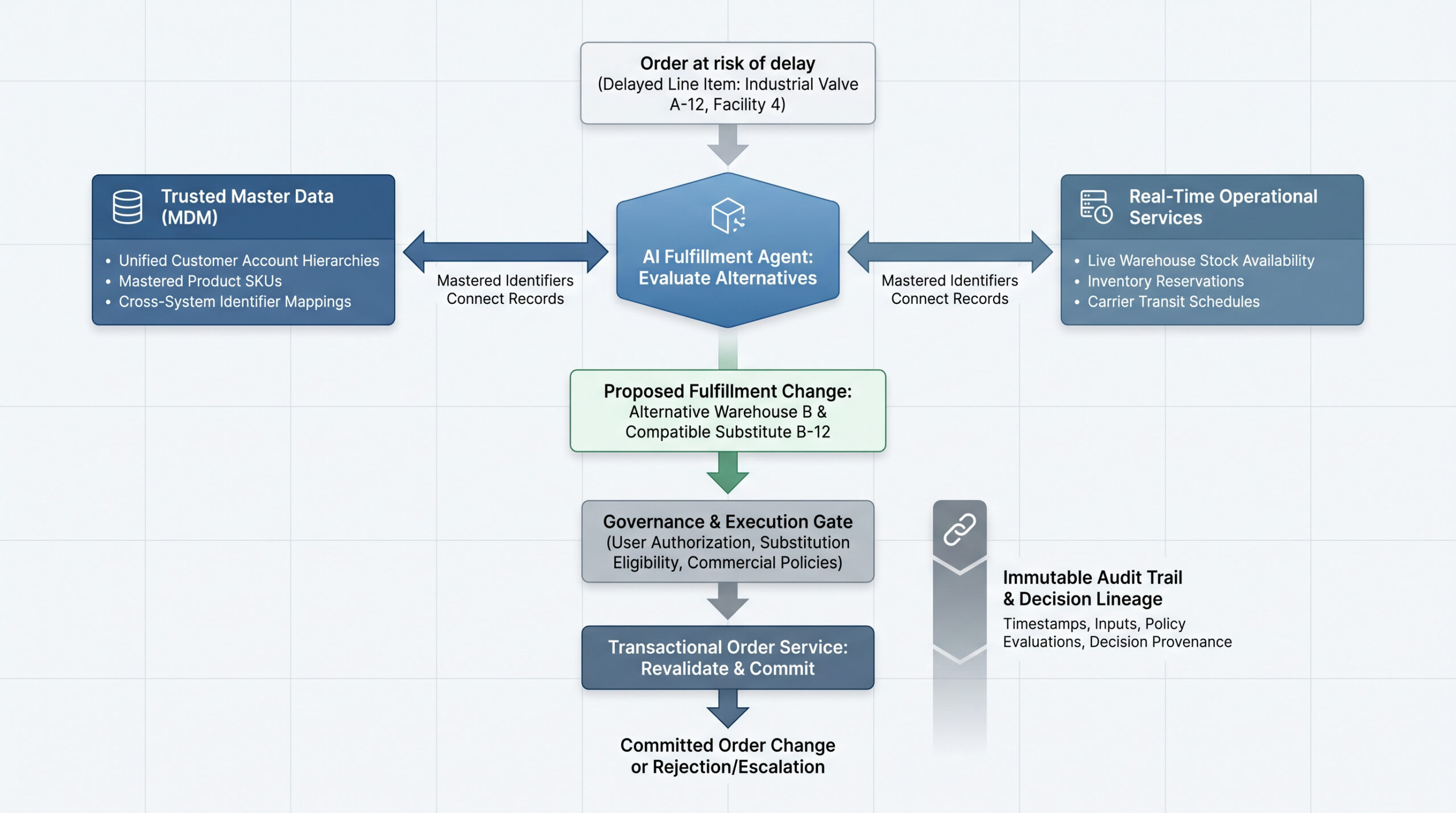
AI agents provide an additional reason to invest in trusted master data, rather than a reason to replace MDM. Consider a hypothetical industrial distributor whose AI agent must resolve an order at risk of delay by considering another warehouse or a substitute product.
Agents require resolved, governed identity before reasoning reliably about customers, suppliers, or products. Master data governance supplies trusted identity, authoritative source rules, relationships, quality signals, and traceability. Without this, an agent’s bad output can become the next agent’s input and carry the mistake through several decisions before anyone catches it.
What an order-fulfillment agent needs before it can act
Identify the customer, product and delivery location
An order management agent may rely on customer, product, and location data. Before proposing an order change, our hypothetical agent needs to resolve these entities consistently across CRM, ERP, and warehouse management systems. Mastered identifiers, cross-system mappings, and active stewardship help prevent the agent from confusing similarly named customers or mismatched product records.
Understand which business relationships apply
Hierarchies connecting subsidiaries to parent companies and products to product families provide context that helps agents apply the right policies, limits, and approvals.
Modern MDM platforms often manage these account hierarchies and customer-to-location relationships natively. You do not necessarily need a separate graph platform to understand them. However, we should distinguish a recorded relationship between product families from a customer-specific substitution entitlement. That specific approval might reside in a separate, authoritative contract management system.
Check the operational facts that can change
A valid product identity does not establish current stock availability, an inventory reservation, or a reliable shipment commitment.
MDM can provide quality, completeness, and confidence indicators for mastered entities. However, these indicators do not establish the current availability of inventory or the status of a shipment. Such operational facts must be retrieved and validated against their authoritative systems before an agent recommends or executes a transaction.
Integration services should connect mastered customer, product, and location identifiers with current inventory availability, warehouse operations, and shipment status from authoritative operational systems.
Freshness, data provenance, and conflicting operational responses determine whether the agent can safely recommend a fulfillment alternative or should pause and seek clarification from a human operator.
Separate a useful recommendation from an authorized action
Proposing an alternative warehouse or eligible substitute does not confer permission to change an order. Defining each agent type as a distinct principal with its own read and write access profile produces tighter and more auditable controls than inheriting existing permission structures.
MDM provides the trusted entity foundation for these decisions, while integration services connect it with operational systems and applicable business rules. Authorization and transactional controls remain responsible for enforcing permitted actions. Together, these capabilities enable organizations to move from reliable data to controlled, AI-supported business processes.
Why better models do not remove the need for MDM
Can an agent infer the right entity from raw records?
AI can assist classification, tagging, anomaly detection, data-quality rule generation, matching, merging, and lineage documentation, but human review remains important because LLMs can hallucinate false entities. Better models deliver diminishing returns on untrusted data; agents typically choose the most likely interpretation unless designed to seek clarification or defer.
Independent identity inference becomes harder to explain and audit as records and dependencies grow. Instead, organizations should use AI-assisted matching within governed resolution workflows. Defined matching logic makes outcomes reproducible for authoritative records used in financial reporting, regulatory obligations, and automated processes.
Does this architecture mean buying another platform?
Executives often object that their existing ERP, MDM, and integration services already cover much of this required functionality. In many cases, that assessment is justified. A relationship store, a semantic layer, or an additional orchestration product should address a demonstrated capability gap.
Existing platforms may fulfill several responsibilities simultaneously, provided that data ownership and system interfaces remain clear.
For instance, MCP-compatible interfaces can provide AI agents with standardized access to governed master data services, potentially reducing the need for custom agent-specific integrations. However, integration with authoritative data sources, identity mapping, authorization, and business logic still requires appropriate engineering and governance.
Build on the MDM capabilities you already have
Map the decision to existing systems and owners
For the proposed fulfillment change, the first step is to map trusted entity identity, business relationships, operational state, and execution controls to their current systems. Each master-data domain needs an accountable business owner responsible for definitions, quality standards, and approving changes.
Next, inspect existing MDM capabilities for hierarchies, relationships, and governance controls before proposing any extensions. Identify missing interfaces, then address them through targeted architectural changes instead of duplicating authoritative data.
For organizations without an established MDM capability, the starting point is to identify the most business-critical master data domains, establish data ownership and authoritative sources, and introduce governance and integration capabilities incrementally. This approach delivers operational benefits independently of AI while creating a scalable foundation for future AI use cases.
Start with recommendations, then expand controlled execution
Begin with an agent that recommends fulfillment alternatives while people retain the authority to approve order changes. During onboarding, use AI to suggest source-to-canonical mappings while retaining manual review before those mappings are adopted. Test ambiguous identities, stale inventory data, and disallowed substitutions before widening the agent’s action scope.
For critical changes, require human approval, log decisions for audit, and enable teams to trace and override AI recommendations. Define evaluation measures such as recommendation correctness, rejected unsafe actions, and exception handling. Run focused enrichment, validation, or stewardship pilots before scaling; add generative AI over existing metadata, reference data, and MDM engines while traditional components execute core processes.
Treat MDM as a strategic foundation for accountable AI
Organizations should strengthen and integrate their trusted master data foundations before expanding AI agents’ authority to modify business records.
Semarchy’s 2026 survey found data management the most pressing AI challenge for 51%; 22% experienced data-quality-related project delays, 21% operational inefficiencies, and 19% compliance issues. IBM research cited by First San Francisco Partners identified quality and governance barriers among nearly 45% of business leaders.
MDM governance preserves attribute origins, survivorship reasons, steward approvals, contributing sources, and permissions.
The practical starting point is not necessarily a new platform or a large-scale transformation programme. It is an assessment of the organization’s existing master data capabilities, critical business entities, integration architecture, and the decisions that depend on them.
For some enterprises, the priority will be establishing MDM capabilities for the first time. For others, it will be extending existing MDM investments, connecting governed master data with operational systems, and making trusted information accessible to AI applications.
At Struct4, we help organizations design, implement, and extend MDM and data integration architectures that deliver measurable business value today while supporting more advanced AI use cases tomorrow.
If you are evaluating your master data strategy or exploring how existing data assets can support AI-driven processes, let’s discuss where to start.
any questions?
let’s scope your pilot
From data to outcomes — AI-First, end to end. Tell us what you need to achieve and we’ll show you how fast we can get there.