 PL
 EN
 DE

The AI infrastructure boom is only half the story
From GPUs to AI factories
On November 17, 2026, NVIDIA reported quarterly revenue of $115.8 billion for Q3 FY2027, up 103% year over year. Data Center revenue reached $107.6 billion, an increase of 110% year over year. NVIDIA expects fourth-quarter revenue of approximately $130 billion. These results illustrate the scale of demand for AI infrastructure and raise a corresponding question for enterprise leaders: are their data foundations keeping pace?
NVIDIA defines AI factories as systems that integrate energy, chips, infrastructure, models, and applications. It says their purpose is to transform raw data into information that supports business decisions and revenue generation.
Its validated enterprise design extends across hardware and software: the investment direction is integrated production infrastructure, not isolated GPU purchases. The Spiceworks & Aberdeen State of IT 2027 report identifies AI as the leading driver of planned IT budget increases, with overall budgets projected to grow approximately 5.7%.
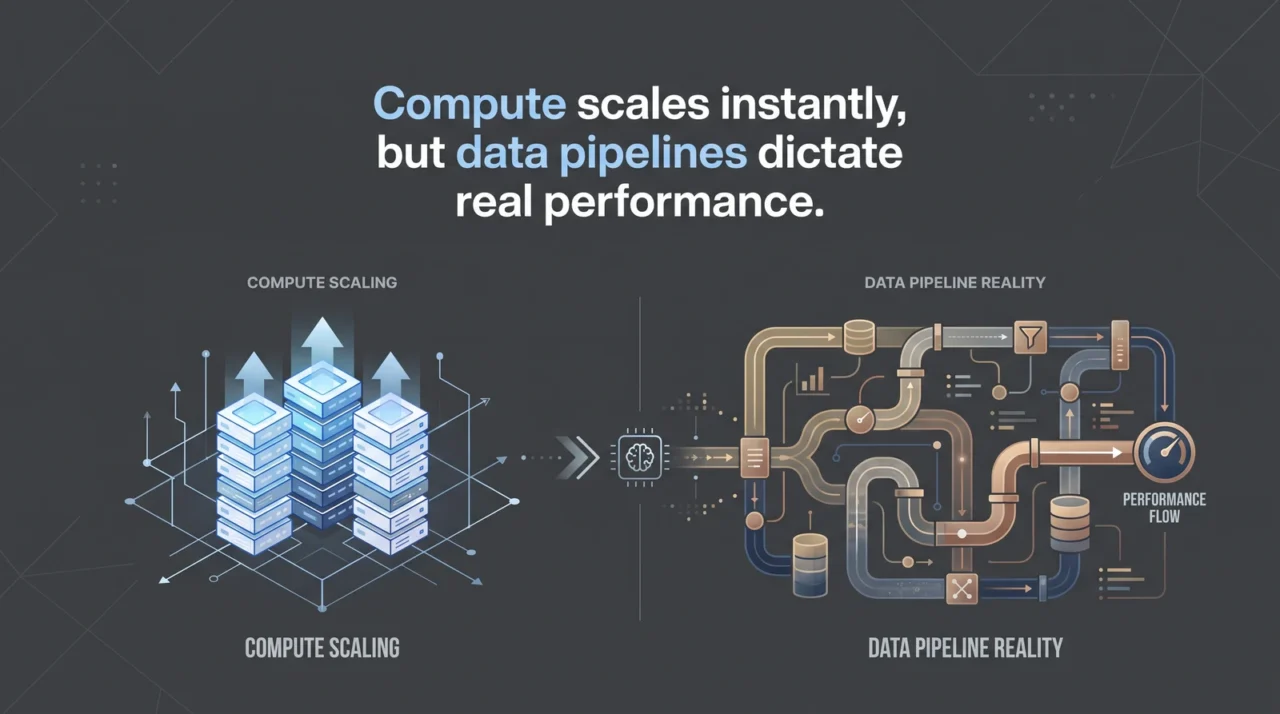
Yet compute capacity is only part of the operational problem: it needs meaningful information.
Why more computing power does not automatically mean more business value
The assumption is that more GPUs and larger models will automatically yield better business decisions.
Models are commercially available. A clean, agreed view of your own business does not come with them.
In one recent engagement, the client brought five data domains under governance before the first model went live; it felt slower in month two but was faster by month six because nothing had to be rebuilt.
At a financial services client, 96% of customer records across CRM, core banking, payments, and digital channels now match automatically into a single identity.
The hidden bottleneck: enterprise data readiness
Fragmented systems, inconsistent data, and legacy architectures
Many enterprise environments were not built for artificial intelligence.
They were built to run specific departments.
A typical mid-market company has customer data scattered across a CRM, a billing platform, an ERP, and a dozen spreadsheets.
Each system holds a slightly different version of the truth.
Among AI programmes the source was asked to rescue, failures were attributed not to the model but to the absence of an agreed definition of a customer, product or asset.
Consider a telecommunications operator trying to automate service incident responses.
The model might be brilliant at parsing network logs.
But if it relies on batch-processed customer data from yesterday, it may misidentify which enterprise clients are currently offline.
It can learn your internal inconsistencies, repeat them at scale, and present them with unwarranted confidence.
Why AI needs trusted, contextual, and timely information
Outdated or conflicting information can lead an AI agent to make bad decisions faster.
AI agents operating across business systems need reliable data access, clear permissions, and traceable information to function safely.
An agent reordering inventory needs to know if a specific supplier is approved.
It needs to know if a contract restricts certain alternative products.
Without a governed data supply chain, that context may be missing.
What an enterprise data supply chain actually looks like
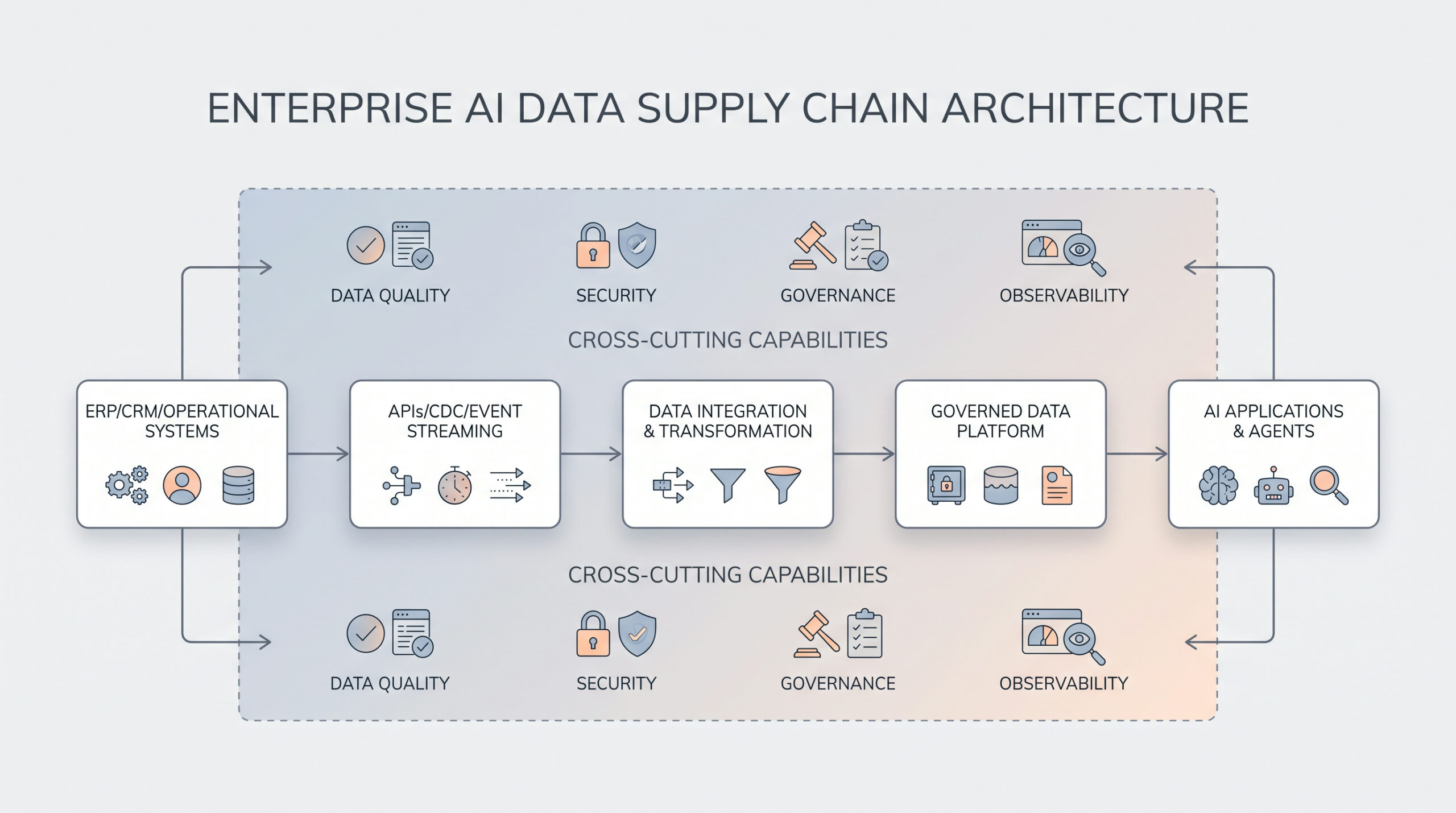
Connecting operational systems through modern data integration
Siloed data and difficulty integrating data sources are the leading obstacle to preparing data for AI, cited by 56% of respondents; data quality or bias issues rank third at 41%.
Only 23% of respondents say their organization has an established data strategy for AI adoption, while 53% are actively developing one; sensitive-data and privacy protection (59%), data quality (46%), and data governance (41%) rank as the most critical strategy components.
A practical data supply chain connects operational sources to AI consumption layers incrementally.
In the described Sentinel integration design, the enterprise service bus ingests source data through JDBC connectors, REST APIs, and batch files, while distributing golden records to target systems through push, pull, and subscriptions; Kafka provides change data capture (CDC) for golden-record updates.
Between ingestion and delivery, pipelines validate, clean, standardize, reconcile, and publish records; orchestration controls sequencing, scheduling, error handling, and retries.
From batch processing to CDC and event-driven data flows
Traditional batch processing is fine for monthly reporting.
For time-sensitive fraud detection or network incident monitoring, an agent needs data as events happen.
Change data capture and event streaming support those workloads.
In the documented design, CDC distributes changes to published records, while event-stream subscriptions deliver reference-data updates to subscribing systems in real time.
Not every AI workload requires real-time data. But when an agent is authorized to take time-sensitive action, stale data creates an operational risk.
Data quality, governance, and observability
If data drifts, you need to find out before the model does.
In the described Sentinel data-quality design, Great Expectations acts as a circuit-breaker at two points in the pipeline: after input validation and before building the golden record, and sends validation results to DataHub as a DQI score.
Freshness, volume, and field-level checks make pipeline health observable; named owners and configured freshness requirements establish accountability for failures. Documented, enforced governance and cross-functional access are also readiness requirements, not substitutes for one another.
In the described Sentinel metadata design, Apache HOP metadata events automatically build end-to-end lineage from source through validation, cleaning, deduplication, merging, the golden record, the ESB, and target systems.
If an AI agent makes a questionable decision, you need to be able to trace the data behind it.
From infrastructure investment to measurable AI outcomes
Where real-time data creates business value
Value is created when timely data meets an operational bottleneck.
In telecommunications, proactive network assurance relies on correlating real-time alarm data with customer contract SLAs.
In industrial operations, predictive maintenance requires streaming sensor data integrated with ERP inventory levels.
The latency of your data can limit the speed of your business decisions.
Measuring ROI beyond model performance
Measure AI success beyond inference speed or benchmark accuracy.
Those are technical metrics, not business outcomes.
According to Newnam, “I think the way enterprises really start to see ROI is project-based AI”.
ROI means reduced resolution times, fewer manual interventions and lower operational costs.
Sentinel’s documentation states that its golden record is updated after every processing cycle, so reports use consistent data.
When you assess an AI investment, include the end-to-end costs: integration, governance, and the data supply chain that makes it work.
A practical starting point for CIOs and CTOs
Assess data readiness before scaling AI
The leading obstacles to preparing data for AI are siloed data or difficulty integrating sources (56%), lack of a clear data strategy (44%), data quality or bias issues (41%), and regulatory constraints on data use (34%).
TechTarget’s data-readiness checklist asks whether data-quality metrics exist, ownership is defined, cross-functional access is enabled, governance is documented and enforced, and relevant teams are trained in data literacy.
I ask executives to map the operational systems required to support a use case.
- Select one consequential operational process and identify where time or money is being lost.
- List only the data domains it needs; document shared definitions and name a business owner for each.
- Measure the share of records passing agreed quality rules and establish how source-data changes will be detected.
- Check access, governance enforcement, and team readiness; use freshness checks to expose delayed inputs before expanding the pilot.
Modernize incrementally instead of replacing everything
TechTarget recommends piloting an AI program in phases to minimize risk and address challenges quickly, then scaling it with continuous monitoring and optimization.
Do not treat every new technology as a mandate to replace what came before it.
Starting from scratch should not be the default recommendation: existing Master Data Management, integration services, data platforms, and governance capabilities can be valuable assets for AI.
Assess whether current integration services can expose the required operational information and existing platforms can support the workload; improve those capabilities before adding another platform.
Build integration layers with reusable pipelines.
I prefer to see an organization prove value on one end-to-end process before extending the architecture.
NVIDIA’s latest results show the scale and speed of the AI infrastructure buildout. But the enterprises that derive lasting business value from AI will also need to connect their operational systems, govern their information and make trusted data available when it matters. The AI factory can produce intelligence. A reliable enterprise data supply chain helps turn that intelligence into measurable business outcomes.
any questions?
let’s scope your pilot
From data to outcomes — AI-First, end to end. Tell us what you need to achieve and we’ll show you how fast we can get there.
